
You're Not Building Momentum. You're Just Busy.


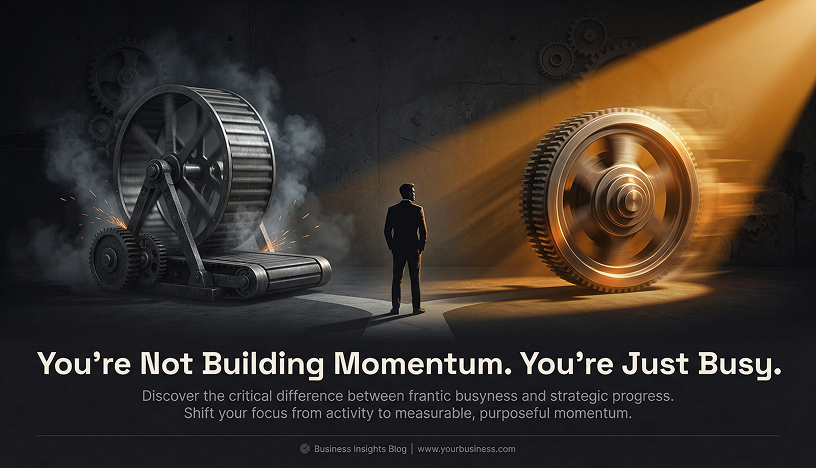
The Difference Between Motion and Momentum.
There is a specific kind of exhaustion that sets in for founders around the five-year mark. The team is bigger. The calendar is fuller. The tools are more sophisticated. And yet somewhere under all of that, revenue has stopped doing what it used to do. Revenue stops climbing the way it once did.
The founder is working harder than ever. The team is shipping more than ever. And the number on the page refuses to cooperate.
This is the plateau. And it is almost never caused by what founders think causes it.
The Trap of Motion
Motion is easy to measure. Number of campaigns run. Number of posts published. Number of features shipped. Number of calls booked. Number of hours logged. All of these are visible, countable, and satisfying in a low-resolution way.
Momentum is harder to measure. Momentum is what happens when each unit of work in the business makes the next unit of work easier, more effective, or cheaper to produce. A content piece that generates a pipeline-ready lead, which lands a customer, whose referral shortens the next sales cycle, whose case study feeds the next content piece. That is momentum. It compounds.
Motion simply continues without compounding. And when founders confuse the two, they end up in a pattern that looks like hustle from the outside but behaves like a treadmill from the inside.
The signal is this. If you removed any single campaign, tool, or initiative from the business today, would the engine slow down noticeably, or would it barely notice? If it would barely notice, that activity is motion. It fills the calendar without building leverage.
Why Busy Feels Like Progress
Human brains are wired to reward movement. A day full of meetings, shipped deliverables, and cleared inboxes triggers the same dopamine loop whether the work is compounding or not. The brain does not distinguish between filling a bucket and filling a leaky bucket. Both feel productive. Only one of them actually makes the water level rise.
Founders, especially founders who built the business on grit, are particularly vulnerable to this loop. Effort has been the competitive advantage since day one. When revenue slows, the instinct is to apply more of the thing that always worked. More effort. More tactics. More channels. The result is usually more motion and no change in momentum.
The Anatomy of a Leaky Bucket
A business in motion, but without momentum, has a predictable shape. Look for these patterns.
Acquisition is constant, but retention drags. New customers come in at the top, old ones quietly leave at the bottom, and the team is running faster every quarter just to keep the net number flat.
Channels are stacked, but not stacked together. Six marketing channels are active. None of them feed the others. Email does not benefit from social. Social does not benefit from events. Paid does not benefit from organic. Each channel runs as its own silo with its own budget and its own dashboard.
Tools proliferate, but data stays fragmented. The stack is comprehensive on paper. In practice, no single report tells you what is actually working. Reporting is reconstructed each quarter from stitched screenshots.
Team capacity is maxed, but no one can explain what moved the number. Everyone is busy. Nobody can point to the three initiatives that actually drove revenue. The narrative of success lives in anecdotes, not in evidence.
Any two of these indicate a leaky bucket.
The Shift to a Flywheel
At Herald, we talk about growth in the shape of a flywheel because the physics of it are exactly right. A flywheel takes sustained effort to get moving. Once it is moving, each push takes less energy than the last, because the wheel is already carrying kinetic energy.
A flywheel has three traits a bucket does not.
Every activity feeds another activity. Content feeds SEO, which feeds lead capture, which feeds sales, which feeds case studies, which feeds content. The loop is intentional. There are no orphan initiatives.
Every initiative is tied to a constraint. Work is not dispatched based on what feels urgent. It is dispatched based on what, if improved, would unlock the next level of growth. That is the whole point of diagnosis. Find the one or two levers whose movement actually matters, and put the team's weight against them.
Outcomes compound over quarters, not weeks. A flywheel rarely shows dramatic week-over-week wins. It shows boring, upward quarter-over-quarter lines that become impossible to ignore at the one-year mark.
How to Diagnose Which One You Are Running
Here is a short exercise that takes about fifteen minutes.
List every recurring initiative in the business. Every meeting, every campaign, every process, every reporting cadence. Next to each one, answer a single question. If we removed this today, what breaks in the next ninety days?
If the answer is "nothing significant," that is motion. Kill it or redesign it.
If the answer is "pipeline slows, retention drops, a specific metric regresses," that is momentum. Protect it.
Most founders discover, to their discomfort, that somewhere between a third and half of what their business is doing every week is motion. It feels necessary because it is familiar. It is simply ballast.
The Real Work Is Subtraction
The fastest way to build momentum is to remove the initiatives that were never compounding in the first place.
This runs counter to every instinct in a founder-led business. The culture rewards adding. Adding feels like leadership. Subtracting feels like giving up. But every hour a team spends on an initiative that does not feed the flywheel is an hour stolen from one that would.
Growth on purpose means choosing what not to do. It means being ruthless about which activities earn their place in the week, and which ones are simply showing up out of habit. It means building the business around a small number of compounding loops, and letting the rest go.
What Comes Next
The plateau signals that the model that got you here is no longer the model that gets you there. The next gear requires redesigning the system so that the work starts compounding again.
You are simply busy. There is a difference. Finding it, and then acting on it, is the single highest-leverage move a founder at the plateau can make.