
Your Marketing Isn't Broken; Your Offer Is.


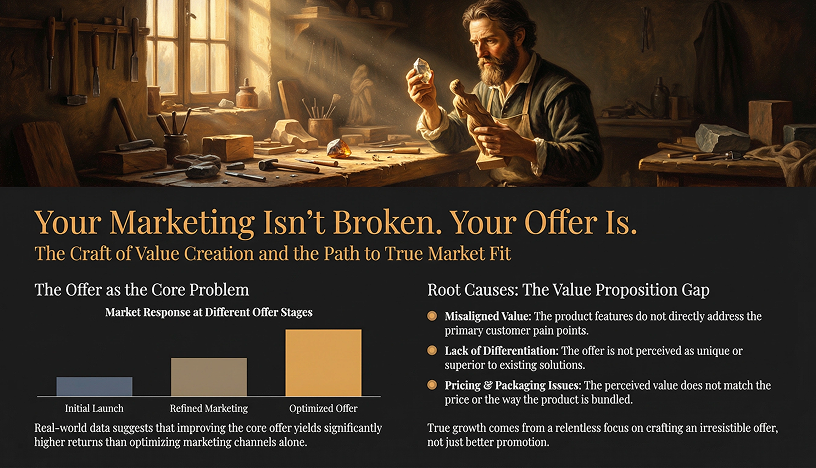
Your Marketing Isn't Broken; Your Offer Is.
The call usually sounds the same. "We need to fix our marketing." Revenue has slowed. Leads are coming in but not closing. The team has tried three agencies in two years. Now the founder is ready to try a fourth, bring it in-house, or pour more money into paid acquisition until something changes.
Almost none of these moves fix what is actually wrong. The problem, nine times out of ten, is the offer the marketing is being asked to sell, not the marketing itself.
The Diagnosis Most Founders Miss
Marketing is an amplifier. That is its fundamental nature. It takes whatever you hand it, an offer, a message, a price, or a promise, and projects it into the market at scale. If what you hand it is clear, compelling, and priced correctly for the value it creates, marketing amplifies its impact. If what you hand it is vague, undifferentiated, or misaligned with what the market actually wants, marketing makes that vagueness bigger too.
This is why so many founders end up burning through agencies. Each agency rebuilds the funnel. Each agency rewrites the copy. Each agency runs the ads. And each time, the underlying offer remains untouched, so the results oscillate inside the same narrow range. A new agency delivers the same offer through a different mechanism, not a new outcome.
How to Tell If Your Offer Is the Problem
There are four signs, and almost every founder-led business has at least two of them running quietly in the background.
Sign one. Conversion rates are flat across every channel. If organic, paid, email, and referral traffic all convert within a narrow band, the issue is probably not channel-specific. It is offer-specific. Different channels should produce different behaviors. When they do not, the bottleneck resides in the offer itself, not in its promotion.
Sign two. Sales calls keep circling the same objections. If you hear "too expensive," "not the right time," or "I need to think about it" on most calls, the offer has a value clarity problem. The prospect cannot tell, quickly enough, what they are getting, why it is worth the price, and why now matters more than later.
Sign three. The buyer cannot describe your product in their own words. Ask a recent customer what you do. If their answer is a paraphrase of your homepage, your messaging resonates, but your offer does not. A strong offer makes buyers say what they got in language you did not write.
Sign four. You are competing primarily on price. Price competition is almost always a symptom of weak differentiation. When the offer itself is unclear or commoditized, price becomes the only lever left, and the race to the bottom begins.
Any two of these signals indicate that the next marketing agency you hire will likely produce the same result as the last three.
The Offer Is a System, Not a Paragraph
Founders often reduce the offer to a pricing page or a sales one-pager. The actual offer is broader, which makes it harder to fix.
The offer is the promise you make. The outcome the buyer receives, stated plainly enough that they could explain it to their boss in a sentence.
The offer is the structure. What is included, what is not, how the engagement is scoped, and whether the package aligns with the buyer's preferences.
The offer is the proof. The evidence that the promise has been delivered before, ideally in contexts similar to the buyer's own situation.
The offer is the price. Not just the number on the page, but the price relative to the outcome promised, the risk the buyer takes on, and the alternatives they are comparing you against.
When any one of these four layers is weak, marketing cannot compensate for it. You can optimize the hook, the headline, the funnel, the retargeting, the email sequence. None of that overrides a buyer's intuition that the thing they are being asked to buy is not worth what it costs.
What a Real Offer Audit Looks Like
At Herald, this is where the COMPASS framework earns its keep. The O in COMPASS stands for Offer and UX Mapping; it is where a significant share of our diagnostic hours land. Because if the offer is wrong, nothing downstream works.
We look at the full path. From first touch to closed deal, every point where a buyer makes a decision gets mapped, measured, and pressure-tested. We look at where attention is lost. Where trust is gained or surrendered. Where pricing meets perception. Where the structure of the package forces the buyer to say yes or no to something they would rather half-commit to.
The output is almost never "run better ads." It is usually some version of "restructure the offer, reposition it against the real alternatives, clarify the promise, and then let marketing do its actual job."
When that sequence runs in the right order, the marketing that was broken last quarter becomes the marketing that is producing reliable pipeline two quarters later. Not because the media plan changed. Because the offer itself finally became something worth selling.
Why the Instinct Is to Blame Marketing
Blaming marketing is the path of least resistance, which is exactly why founders default to it.
Marketing is outsourced. Agencies can be fired. Channels can be paused. Campaigns can be rewritten. All of that feels like decisive action, and all of it avoids the harder conversation. Which is that the offer itself, the product of many years of founder decisions, might be the thing capping growth.
That conversation is uncomfortable. It touches pricing, positioning, scope, and the founder's own relationship with what the business sells. But it is the conversation that actually moves revenue.
The Rewrite
Here is the rule, clean and unambiguous. Marketing amplifies what is already true about your offer. If the offer is strong, marketing makes you bigger. If the offer is weak, marketing makes the weakness visible, expensive, and faster to spread.
The next time you are about to hire a new agency, pause. Before you sign anything, run the offer audit. Ask whether the promise is clear, the structure is right, the proof is credible, and the price matches the value. Fix whichever layer is weak. Then, and only then, put marketing dollars behind it.
Revenue does not start with the ad. It starts with the offer. Get that right, and the rest of the system becomes a worthwhile investment.