
The New Front Door: Why Your Buyers Are Finding Your Competitors on ChatGPT
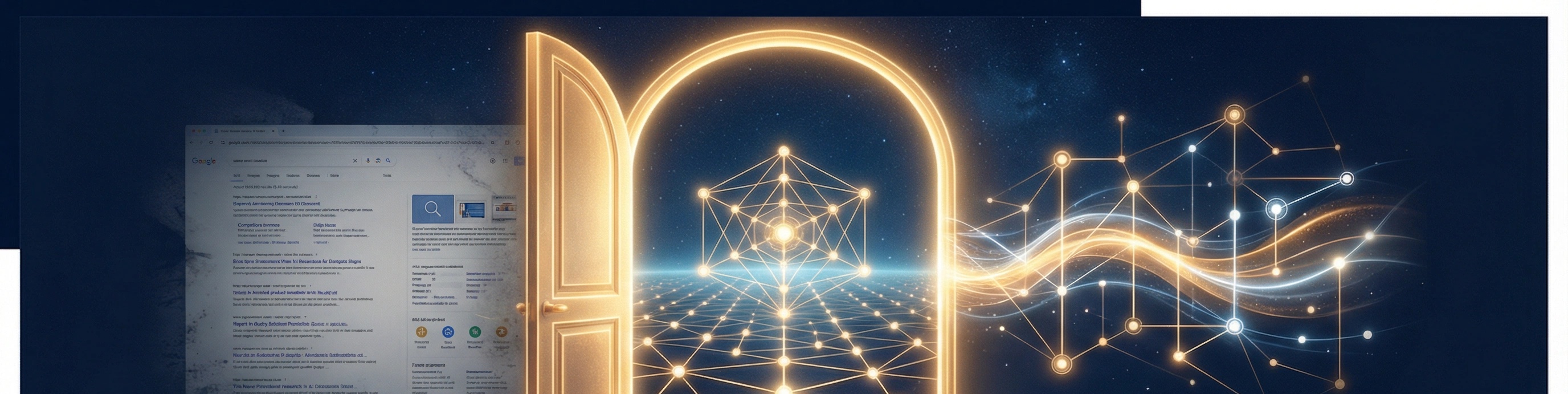
Imagine this scenario. It is Tuesday morning. You are looking at your monthly marketing report. Traffic is steady. Your core keywords are ranking on page one of Google. The SEO agency you hired last year is sending you charts that go up and to the right. You feel good. You think you have built a machine.
But you have not. You are just admiring a snapshot of a world that no longer exists.
While you were optimizing for Google's algorithm, your best prospects stopped using it. They did not go to another search engine. They went to ChatGPT. They went to Perplexity. They started asking AI Overviews to do their vendor research for them.
This is not a prediction about the future. It is a diagnosis of your present reality.
Recent data shows that 80 percent of B2B buyers now start their research on AI platforms, not traditional search engines. McKinsey reports that half of all Google searches already feature AI summaries, a number expected to climb past 75 percent in the next two years.
The game has fundamentally changed. You are no longer optimizing for clicks. You are optimizing for citations.
The Broken Engine of Traditional Search
For the last decade, we treated digital marketing like a manufacturing line. You put keywords in, you get rankings out. You pour leads into the top of the funnel, and you extract revenue from the bottom.
It was linear. It was measurable. And it was seductive.
But that engine is broken. The traditional search funnel is a leaky bucket. When a prospect types a query into Google today, they are not looking for ten blue links. They are looking for an answer. And increasingly, AI is giving it to them directly without ever sending them to your website.
This is the rise of the zero-click search. If your growth strategy relies on users clicking through to your blog to read a 2,000-word SEO article stuffed with keywords, you are running on a treadmill. You are expending massive amounts of energy just to stay in the same place.
Answer Engine Optimization (AEO): The New Battlefield
This is not an SEO problem. It is a discoverability problem.
When a founder-led business hits a growth plateau between $10M and $50M, the constraint is rarely a lack of effort. The constraint is usually a misalignment between how they sell and how their market actually buys.
Right now, your market is buying through conversation with AI. They are not searching for the best B2B logistics software. They are prompting: I run a $20M manufacturing company with complex supply chain needs. What logistics software integrates best with our current stack and offers the lowest total cost of ownership?
To win in this environment, you have to shift from Search Engine Optimization (SEO) to Answer Engine Optimization (AEO).
AEO is the practice of structuring your content so that Large Language Models (LLMs) understand, trust, and cite it when generating responses. It requires a fundamental shift in how you produce and publish information.
Here is the contrast you need to understand: Traditional SEO optimizes for the algorithm. AEO optimizes for the answer. Traditional SEO wants the click. AEO wants the citation. Traditional SEO relies on keyword density. AEO relies on entity authority and structured data.
How to Stop Running on the Treadmill
If you want to build a growth system that actually compounds, a flywheel instead of a funnel, you have to adapt to how AI evaluates authority. Here is the diagnosis of what needs to change in your marketing operations today.
Stop writing for robots; start answering real questions. AI models are trained to synthesize information and provide clear, direct answers. If your content is buried under layers of marketing fluff and buzzwords, the AI will ignore it. You need to identify the exact, complex questions your best buyers are asking and answer them comprehensively. Diagnosis before prescription.
Build undeniable entity authority. AI does not just read your website; it reads the entire internet. It looks for consensus. If you claim to be the premier solution in your space, but no one else on the internet agrees with you, the AI will not cite you. You need digital PR, strategic partnerships, and authoritative backlinks more than ever. Your brand needs to become a recognized entity in the AI knowledge graph.
Structure your data for synthesis. You cannot rely on the AI to guess what your content is about. You must use schema markup and clear, hierarchical formatting to make it effortless for the model to extract your insights.
The Stewardship of Clarity
At Herald, we believe that marketing excellence is more than profit. It is a form of stewardship.
When you refuse to adapt to how your buyers are searching for truth, you are doing them a disservice. You are hiding the solution they desperately need behind an antiquated system.
Adapting to AI search is not about chasing the latest tech trend or finding a new growth hack. It is about removing friction. It is about serving your future customers with clarity and precision exactly where they are already looking for help.
The transition from Google to AI is happening whether you participate or not. The businesses that recognize this shift and restructure their growth systems to optimize for answers will build compounding momentum. The ones that do not will find themselves perfectly optimized for a search engine their buyers no longer use.
Stop refilling the leaky bucket. Start building the flywheel.
Ready to Build Your Legacy?
We have a limited number of spots available in The Herald Collective to ensure we provide the highest level of partnership. Book a free, no-obligation discovery call today to see if you qualify.