
The Founder Bottleneck: Why Your Business Isn't Scaling (And It's Not What You Think)
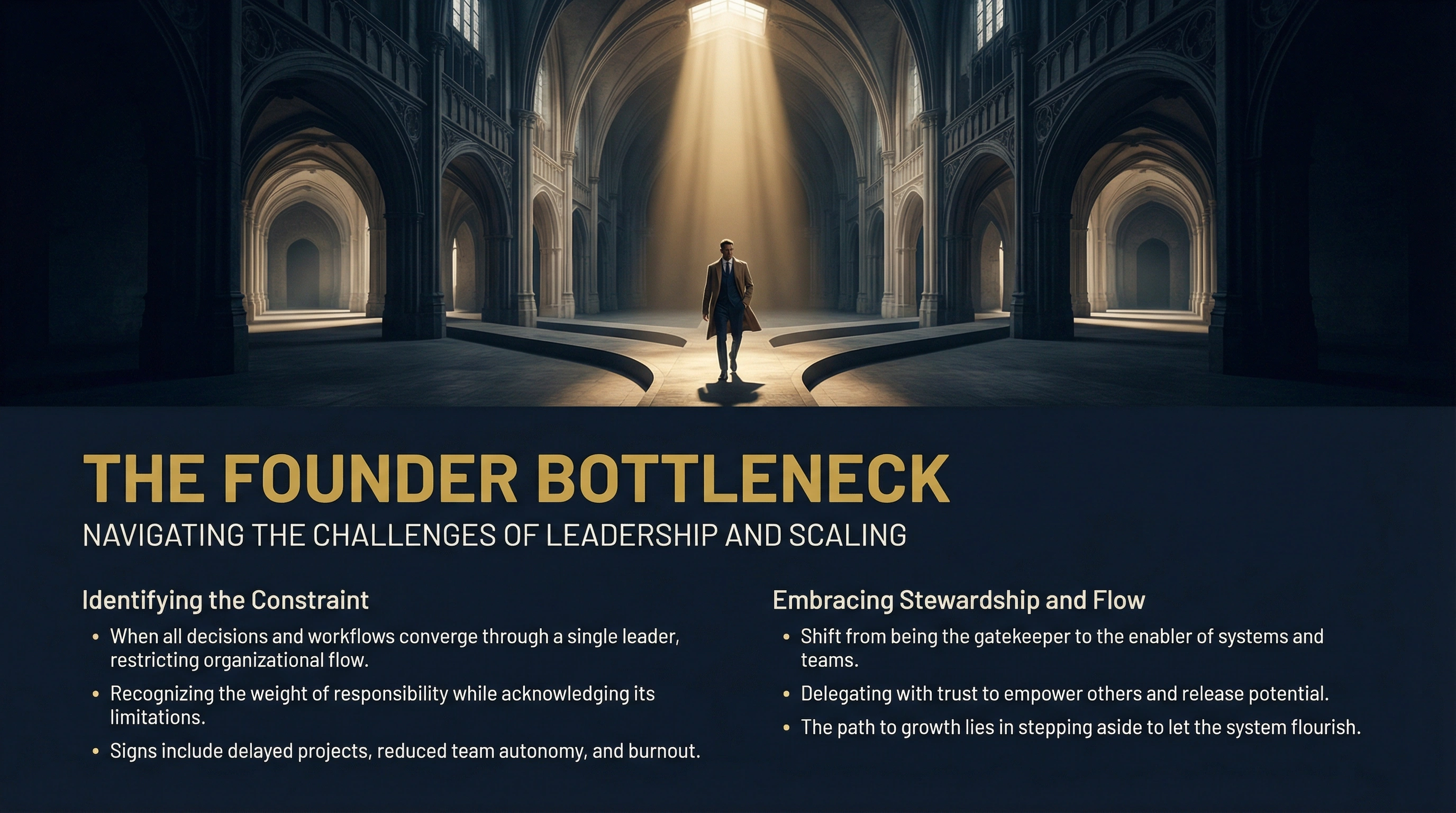
It's 4:00 p.m. on a Thursday. You're staring at a Slack channel filled with questions that only you can answer, an inbox that hasn't been empty since 2021, and a revenue dashboard that has barely moved in three quarters.
From the outside, you look like a success story. You've crossed the $5 million mark. You have a team. You have a brand. But on the inside? You feel like you're pushing a boulder uphill every single day, only to watch it roll back down the moment you step away for a weekend.
You think you have a growth problem. You think you need more leads, better marketing, or a new sales script.
You don't.
You have a dependency problem.
Most founder-led companies don't fail because they lack ambition or hustle. They plateau because the business outgrows the founder's operating system. What got you to your first million—sheer force of will, being involved in every detail, heroically saving the day—is exactly what prevents you from reaching ten million.
This isn't a marketing issue. It's a design issue. You haven't built a machine; you've built a job with a very impressive title.
The Leaky Bucket of Founder Dependency
I've seen this pattern repeatedly with businesses doing $1M to $50M in revenue. The founder is convinced they need a new funnel to break through their current plateau. They hire agencies, run ads, and pour money into the top of the system.
But the system is a leaky bucket. And more often than not, the founder is the leak.
When every major decision, every client escalation, and every strategic pivot has to run through you, you become the ultimate bottleneck. Your team can only move as fast as your capacity to approve their work. Your revenue can only grow as large as your calendar allows.
You are on a treadmill. You are running faster, sweating more, and putting in longer hours, but you aren't actually moving forward. You're just getting better at staying in the same place.
Investors know this. There is a hard truth in the world of acquisitions: buyers do not pay a premium for businesses that cannot survive without the founder. A company that relies entirely on your heroic effort is a liability, not an asset. If you want to scale—whether for an exit or simply to reclaim your sanity—you have to design yourself out of the day-to-day friction.
Three Signs You Are the Bottleneck
Diagnosis always precedes prescription. Before you can fix the system, you have to admit where it's broken. If you're wondering whether you are the bottleneck in your own business, look for these three indicators.
First, your team waits for permission rather than taking action. If your Slack messages are filled with "Can you review this?" or "What should we do here?", you haven't empowered a team. You have hired a group of very expensive assistants.
Second, your growth feels like Groundhog Day. You hit a revenue target, celebrate briefly, and immediately feel the crushing weight of having to do it all over again next month. The energy dissipates. There is no compounding momentum, only a constant reset.
Third, your calendar is defensive, not offensive. You spend 80% of your time reacting to client fires, team questions, and operational hiccups, leaving only 20% for the strategic work that actually moves the needle. You are playing defense in your own company.
The Myth of More Hustle
The natural instinct of a driven founder is to work harder. If the system is stalling, you assume you just need to apply more pressure. You try to out-work the bottleneck.
But hustle doesn't scale. Systems do.
As Dan Martell frequently points out, buying back your time doesn't work if every decision still requires your input. You can delegate tasks, but if you haven't delegated authority and installed clear frameworks for decision-making, you haven't actually bought back anything. You've just added a layer of management between you and the work you're still secretly controlling.
Focus, as Alex Hormozi notes, is achieved through subtraction, not addition. Growth isn't about doing more things; it's about doing fewer things exceptionally well, and building systems that handle the rest.
Installing the Operating Current
So, what does the fix actually look like? It requires a fundamental shift from a funnel mindset to a flywheel mindset.
In the COMPASS Method, the 'P' stands for Personnel Assessment—the understanding that your team is the strategy. You cannot scale a business on the back of one person's intuition. You have to extract your intuition, codify it into an operating system, and train your team to execute against it.
This means moving from implicit expectations to explicit standards. It means creating scorecards instead of micromanaging tasks. It means letting your team fail on small things so they can learn how to succeed on big things without you.
It requires building an operating current—a rhythm of communication, accountability, and execution that pulses through the business whether you are in the room or not.
Stewardship Over Heroics
We often talk about business growth in terms of metrics: revenue, margins, EBITDA. But at its core, building a sustainable business is an act of stewardship.
When you build a company that depends entirely on you, you are doing a disservice to your team, your clients, and the mission you set out to achieve. You are capping the impact your business can have because you are unwilling to let go of control.
True leadership isn't about being the hero who saves the day. It's about building a system that doesn't need saving.
It's time to step off the treadmill. Stop trying to out-work your lack of systems. Diagnose the real bottleneck, design the operating current, and build a business that scales with clarity, momentum, and purpose.
Ready to Build Your Legacy?
We have a limited number of spots available in The Herald Collective to ensure we provide the highest level of partnership. Book a free, no-obligation discovery call today to see if you qualify.